
I started taking long-haul flights seriously about four years ago, first for work, then for the sheer habit of it. Seattle to Tokyo, twice a year. Portland to London for a family trip. A few transatlantic routes in between that I booked mostly for the miles. The one thing that never got easier was sleeping on a plane, until I stopped relying on whatever the airline handed me in a thin plastic bag. About six months ago I picked up the MLVOC neck pillow after burning through two cheap inflatables and a microbead tube that basically evaporated its padding after six washes. I have now traveled with the MLVOC on eight flights, the shortest at four hours and the longest at just over thirteen, and I have a clear picture of exactly what it does well, where it falls short, and who it is actually built for.
The MLVOC positions itself squarely in the memory foam category and bundles a 3D eye mask, earplugs, and a carry bag alongside the pillow itself. At its current price it sits below most mid-tier travel pillows while offering more accessories than most. My review covers the memory foam quality over multiple wash cycles, how the hood design performs in practice, whether the bundled accessories are worth anything, and what six months of real use has actually revealed. The short answer is that the MLVOC earns its place in my carry-on, but with a couple of caveats you should know before buying.
The Quick Verdict
Genuinely supportive memory foam, a better-than-average kit, and a price that makes it easy to recommend for most long-haul travelers, though the hood runs small and the cover takes longer to dry than you'd like.
Amazon Check Today's Price →If your neck aches every time you land, this is the pillow to try first.
The MLVOC packs 100% memory foam support into a travel kit that costs less than a meal at the airport. Check today's price on Amazon before it changes.
Amazon Check Today's Price on Amazon →How I've Used It
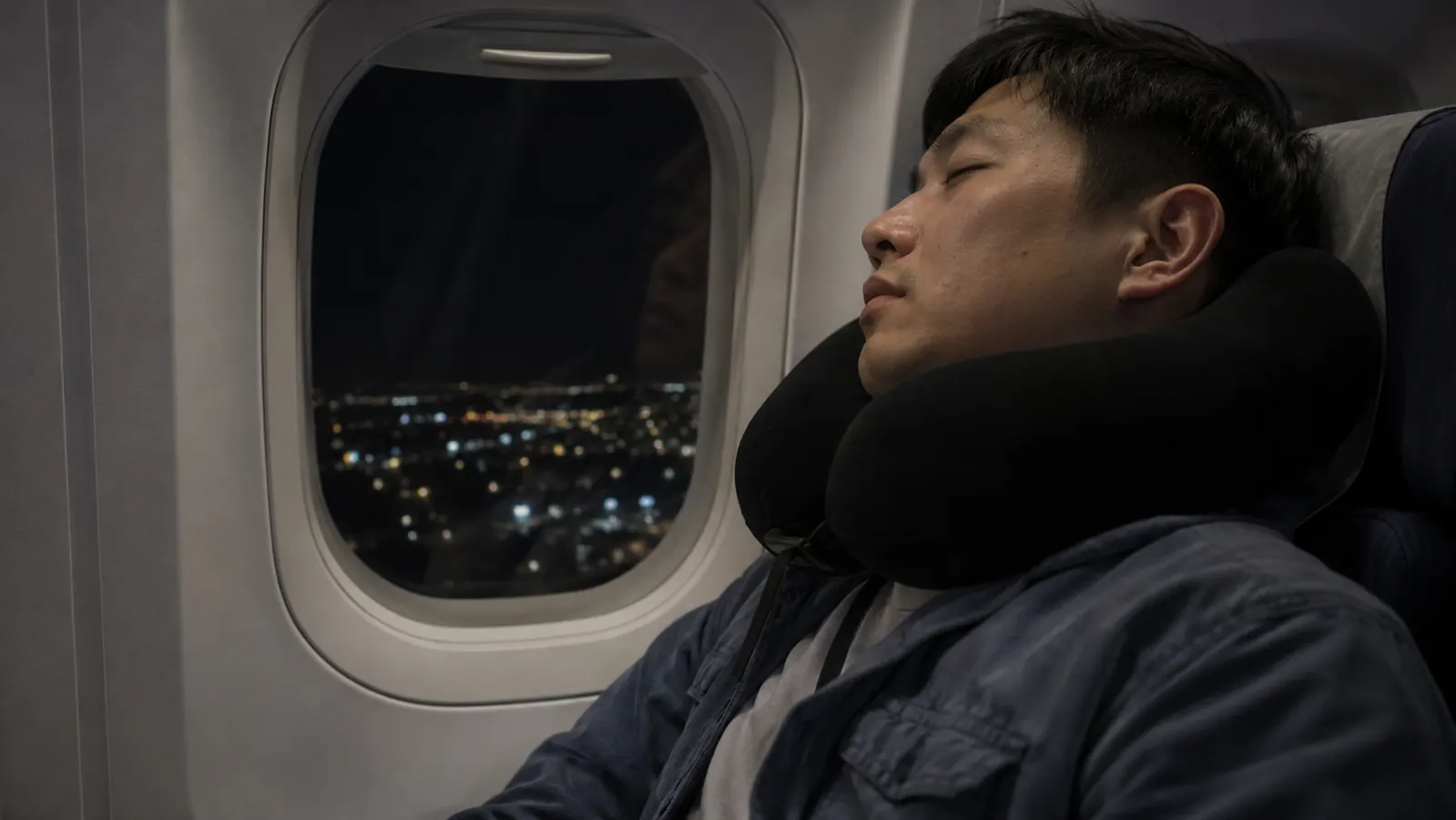
My first test with the MLVOC was a SEA-NRT leg in January, thirteen hours and twenty minutes in economy on a Boeing 777. I had a window seat, which helps, and I positioned the pillow with the opening facing the front so the taller side sat at the back of my neck rather than under my chin. That orientation is the one the MLVOC documentation suggests and it immediately felt different from the standard U-shape I'd been using for years. The foam conformed to my neck within about ten minutes of sitting still, and I woke up with no stiffness on arrival, which had not happened on that route in three prior trips.
Between January and June I logged the MLVOC on a Portland to London round trip in March, two domestic legs (SEA-ORD, four hours each way) in April, a SEA-CDG run in May, and a five-hour hop to Cancun for a friend's wedding in June. Across all of those flights I washed the cover four times in a standard front-loader on the gentle cycle and air-dried it per the instructions. I also tried one machine dry on low to see what happened, which I will cover in the durability section.
My baseline is a neck that already carries some tension from sitting at a laptop five days a week. I have no diagnosed cervical issues but I feel a long flight in my upper traps and the base of my skull the next morning if the support is wrong. That is the lens through which this review is written.
Memory Foam Quality: The Core Claim Holds Up
MLVOC advertises 100% pure memory foam and, based on six months of use, that claim appears accurate. The foam does not collapse into a thin sheet the way budget inflatables do after a few hours of weight. It returns to full shape within about thirty seconds of being uncompressed. After eight trips and four wash cycles, the loft feels identical to what I unboxed in January. I was genuinely uncertain whether the foam would survive repeated washing since most memory foam products specifically warn against full submersion, but the MLVOC design keeps the foam core inside a separate inner liner that you do not wash. Only the zippered outer cover goes in the machine, which makes the durability question mostly about the cover, not the foam itself.
The foam density is on the firmer end of the memory foam spectrum. If you prefer a pillow that feels like sinking into a cloud, this is not that. It is more like firm hotel pillow density, supportive enough to hold your head upright without your neck muscles working to maintain the position. On long overnight flights that firmness turned out to be an advantage. My head did not slowly drift forward the way it does with softer pillows. On shorter daytime flights where I was not actually trying to fall asleep, the firmness was occasionally a little much for casual lounging.
My head did not drift forward once during a thirteen-hour overnight. That had never happened with any pillow I had used before, including options that cost twice as much.
The Hood: Useful in Theory, Sized a Bit Small in Practice
The MLVOC includes a snap-on hood that is meant to block light from the side and give you a little cocoon effect in your seat. I was skeptical of this feature before I tried it. After six months I would call it useful but inconsistent. On overnight flights where I wanted full light blocking, the hood helped on the right-hand side where the window seat puts light from above and to the right. But the hood attaches to the left arm of the pillow and folds over to the right, so if you are seated in a middle or aisle seat it does not do much.
The bigger issue is fit. I wear a medium hat, which is not an unusually large head, and the hood felt snug enough that it created a little pressure at the temple. My travel companion, who wears a small, thought the hood was great. Anyone with a larger head may find it more distracting than helpful. MLVOC does not offer the hood in different sizes, so this is a known limitation. I ended up using the included eye mask instead of the hood on most flights, which worked better for my particular head size.
The Included Kit: Better Than You'd Expect at This Price
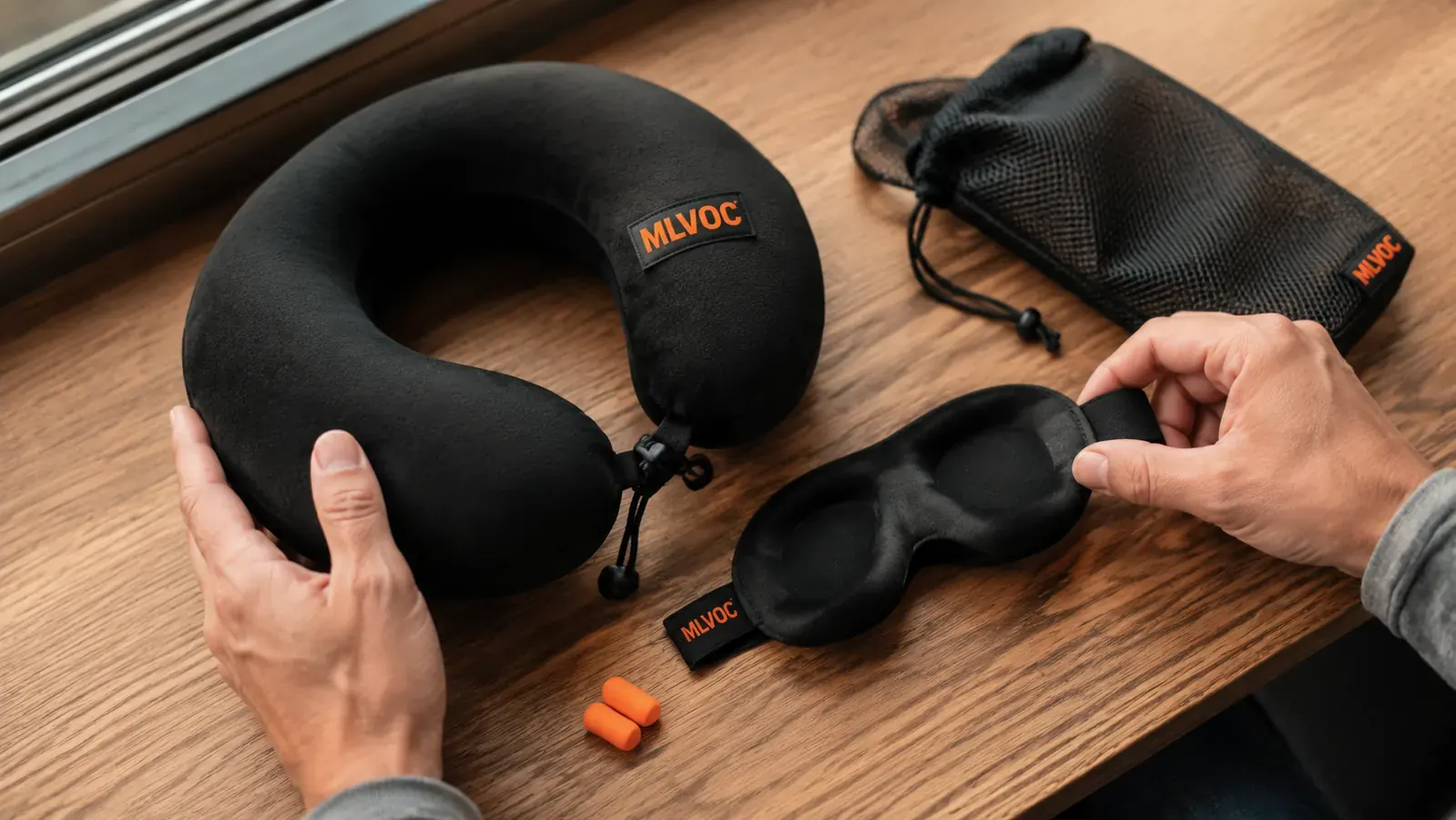
Most travel pillows in this price range ship alone, maybe with a carry bag if you are lucky. The MLVOC includes a 3D contoured eye mask, a pair of foam earplugs, and a small zippered carry pouch. None of these items will replace a high-end sleep kit but they are considerably better than the throwaway versions airlines hand out.
The 3D eye mask is the standout. The contoured shell keeps the mask off your eyelashes, which eliminates the biggest annoyance of flat eye masks. I used it on the SEA-CDG overnight and managed four hours of actual sleep, which for a daytime departure east is genuinely good. The foam earplugs are standard NRR-29 style plugs, nothing special, but they are the correct shape and they were sitting in the pouch ready to use when I needed them at 3am somewhere over Greenland. The carry bag is nylon mesh, fits the pillow when compressed, and is small enough to clip to the outside of a daypack if you want the pillow accessible before boarding.
The one accessory that disappointed me was the carry bag's zipper. It started catching after the third or fourth use and now requires two hands to open. For a bag that I unpack and repack at security four to six times per trip, that friction adds up. It is a small thing but it is the kind of small thing that accumulates into mild frustration over six months.
Washability and Cover Durability After Four Cycles
The cover is labeled machine washable and it is, mostly. After three gentle cold-water cycles with air drying, the velour fabric looked and felt unchanged. The fourth wash was the low-heat machine dry experiment. The cover came out slightly pilled on the back panel, the part that rests against the seat headrest. Nothing structural broke, no seam separation, no fading. But the velour surface lost a little of its initial softness and the slight pilling is visible if you look closely.
Air drying takes three to four hours in a warm room, which means if you wash the cover the morning of a departure you may be packing a damp cover. That is the main practical inconvenience. I now wash it the night before travel, not the morning of. The cover fits back onto the foam core without any zipper drama, which is not a given with all travel pillows, so that part works well.
What We Liked
- Memory foam holds its loft across six months and multiple wash cycles with no compression or thinning
- Firm enough to keep your head upright without neck muscle effort, even on 13-hour flights
- Bundled 3D eye mask is genuinely useful, not a filler accessory
- Cover is machine washable and separates cleanly from the foam inner
- Price sits well below comparable memory foam options on Amazon
Where It Falls Short
- Hood design runs small and creates temple pressure on medium or larger head sizes
- Cover takes three to four hours to air dry, inconvenient on departure day
- Carry bag zipper becomes sticky after repeated use
- On short daytime flights the foam firmness can feel more rigid than relaxing
- Not adjustable in terms of loft or firmness for different neck lengths
How It Compares to What I've Tried Before
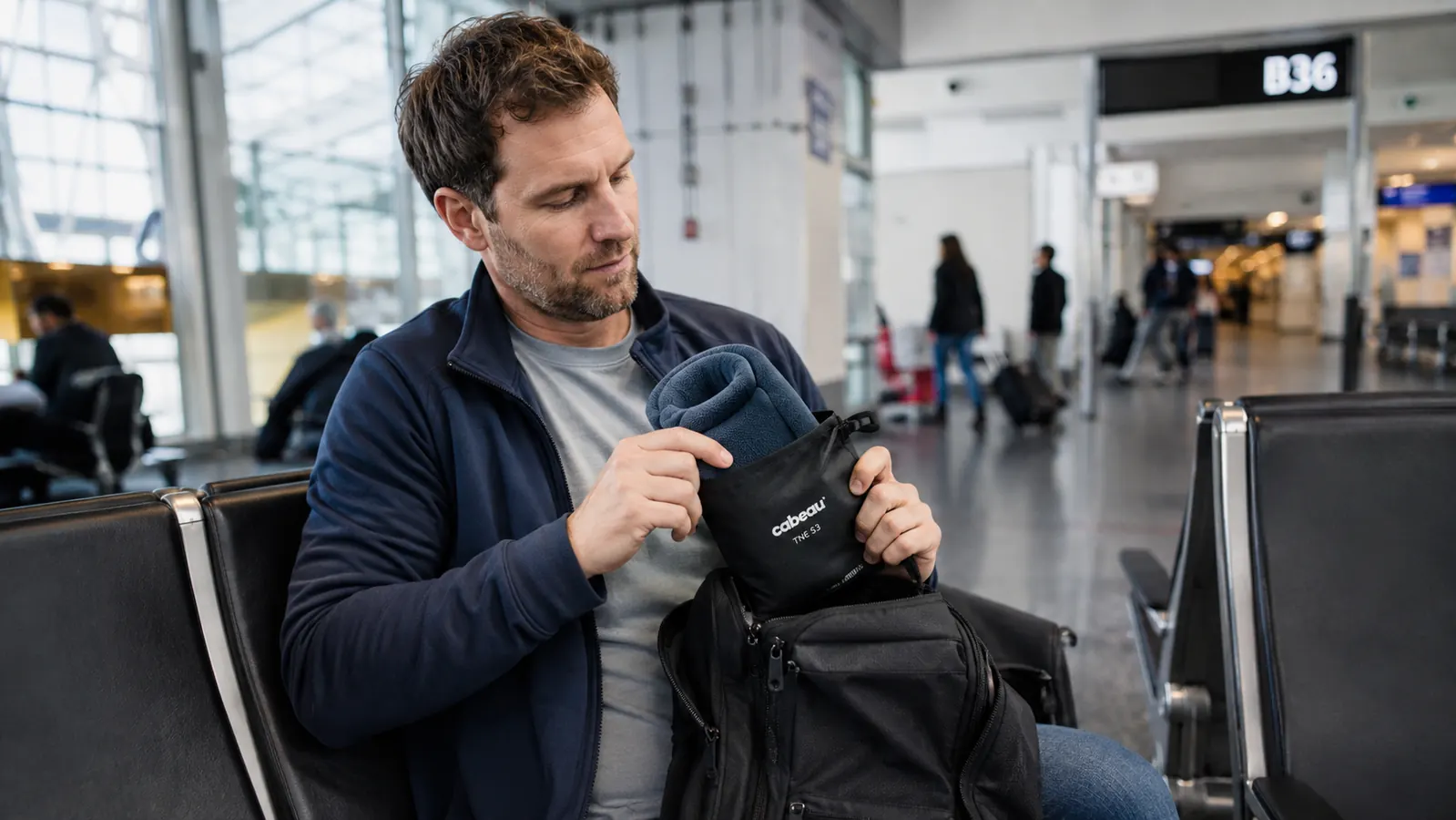
Before the MLVOC I had used two inflatable pillows (one branded, one generic), a microbead pillow that lasted about eighteen months, and a brief experiment with a Cabeau Evolution Classic that I borrowed from a colleague. The inflatables compressed too easily, especially after a few hours of sleep weight on them. The microbead pillow was comfortable but the beads migrated unevenly over time and the wash instructions were basically useless since it just clumped after two cycles.
The Cabeau Evolution is a fair comparison point because it is also memory foam and sits in the same approximate price bracket, though it sometimes runs higher. The Cabeau has a slightly different foam profile, softer and with more give, and its carry case compresses the pillow down to a smaller pack size. If packability is your primary concern the Cabeau is worth comparing directly. But for raw support on overnight flights the MLVOC felt more stable to me, and the bundled accessories tip the value calculation clearly toward the MLVOC at its current price. For a full head-to-head breakdown, see my MLVOC vs Cabeau Evolution comparison.
Who This Is For
The MLVOC is the right pillow if you take flights longer than five hours, you want real neck support rather than just a soft cushion, and you prefer not to spend heavily on a single travel accessory. It is also the right choice if you want a ready-to-use sleep kit rather than building one accessory at a time. The eye mask and earplugs are genuinely good enough to replace what you might have bought separately. Frequent fliers who take two or more long-haul trips per year will find the memory foam durability worthwhile. If you already have a solid sleep kit and just need the pillow, this still makes sense on quality and price alone. For more reasons to make the upgrade, the 10 reasons a memory foam travel pillow is worth it covers the full case.
Who Should Skip It
Skip the MLVOC if you have a larger head or a long neck and need an adjustable-loft design, because this pillow is fixed and the hood will likely frustrate you. Also skip it if you prioritize ultra-compact packing and need your neck pillow to compress down to the size of a baseball. The MLVOC compresses reasonably well but it is still a solid memory foam pillow, not an inflatable that disappears into your bag. Travelers who take mostly short domestic flights under three hours may find the price and bulk hard to justify for occasional use. And if you run hot and want a cooling gel layer in your foam, look at pillows that specifically address that, because the MLVOC runs neutral to warm and that was occasionally noticeable on night flights in warmer cabin temperatures.
Six months and 40,000 miles later, I am still packing this pillow.
If you want real memory foam support with a sleep kit that is actually ready to use out of the box, the MLVOC is the easiest recommendation I can make at this price. Check today's price on Amazon before it changes.
Amazon Check Today's Price on Amazon →